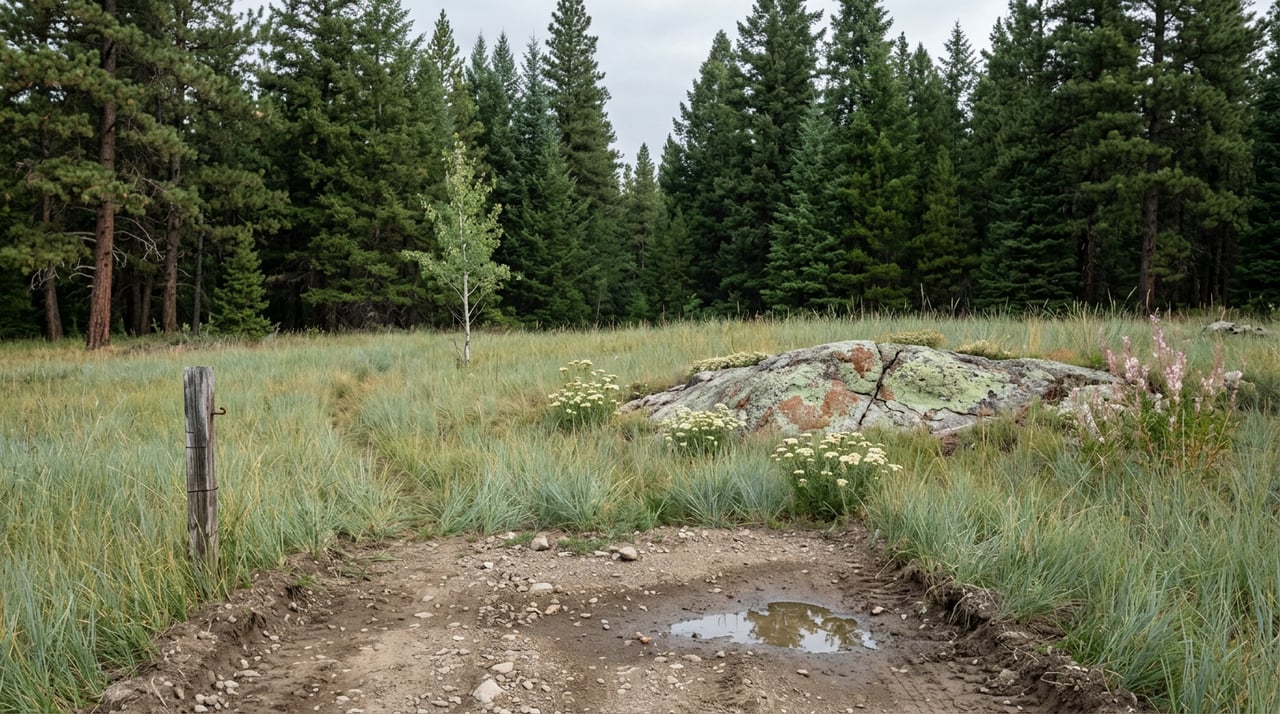
Picture two wooded parcels for sale outside Cameron this summer, both bordering open ranch land, both priced within a few thousand dollars of each other. One measures 18.4 acres. The other measures 21.6 acres. From a truck window they look identical. On paper, they sit on opposite sides of a line that decides who reviews your water and septic plan, how long that review takes.
That line falls at 20 acres, and it is the number Madison County land buyers should be checking before they check the view.
Who Reviews Your File Depends on a Number, Not a Neighborhood
Madison County draws the boundary plainly in its own planning guidance: the county Sanitarian reviews water and sanitation information for subdivision lots greater than 20 acres, while the Montana Department of Environmental Quality reviews everything smaller. That single distinction sends your application to two different offices, with two different queues, two different fee schedules, and two different review timelines.
| Over 20 acres | Under 20 acres | |
|---|---|---|
| Reviewing authority | Madison County Sanitarian | Montana DEQ |
| What gets checked | Water supply and wastewater plan at the county level | Same substance, reviewed under the state's subdivision sanitation rules |
| Practical effect for buyers | Local office, local timeline, local relationships if questions come up | State-level queue, potentially a different pace and a different fee structure |
Buyers comparing two parcels on price alone can miss that the smaller one routes through an entirely different agency. Neither path is inherently slower or faster on any given week, but they are not the same path, and asking which one your parcel falls into before you write an offer tells you who you will actually be dealing with during due diligence.
What the Named Developments Actually Look Like
A few Madison County subdivisions currently on the market illustrate why this matters lot by lot, not just county by county.
- Shining Mountains, off the county-maintained Shining Mountains Loop Road outside Ennis, includes parcels as small as 12 acres, comfortably on the DEQ side of the county's review line.
- Sun West Ranch in Cameron spans more than 2,000 acres, with individual lots sloped and wooded, each carrying a defined building envelope rather than an open build zone.
- Virginia City Ranches has parcels where power, well and septic already serve an existing cabin.
- Madison River Ranches offers timbered 20-acre parcels that sit almost exactly on the threshold this piece is about, which makes confirming the surveyed acreage, not the marketed acreage, worth the extra week before closing.
What It Costs to Get Water and Waste Right
Regardless of which office reviews the file, the physical work costs roughly the same. A complete private well system in Montana, from drilling through pump and pressure tank, typically runs $10,000 to $30,000, with depth as the main cost driver, and current Ennis-area listings disclose well logs running 200 to 350 feet with yields of 12 to 30 gallons per minute, useful context for budgeting a new well against inheriting an existing one. A conventional septic installation runs $3,500 to $15,000, while an engineered system for poor-draining soil can run $10,000 to $25,000 or more. Landmodo notes that most county and state codes require 50 to 100 feet of separation between a well and the nearest edge of a septic system, a constraint that matters on tight or steeply sloped parcels.
As of early August 2026, Madison County's active land inventory is averaging close to $845,000 per listing across roughly 7,300 acres on the market, which means an unbudgeted $20,000 to $50,000 in well and septic work is a real swing in the total cost of ownership, not a rounding error to absorb after closing.
What to Confirm Before You Write the Offer
- The surveyed acreage, not the number on the listing sheet, especially anywhere near the 20-acre line.
- Whether an existing well has a filed log and what its tested yield actually was.
- Whether an existing septic system has an active permit on file with Madison County, and when it was last pumped.
- Whether recorded ditch shares or water rights are appurtenant to the parcel itself or held separately by a mutual company.
The acreage on the listing sheet does not just decide your view. In Madison County, it decides your reviewer.
A Few Questions Worth Asking Directly
What if the subdivision already has a shared well system instead of individual wells? Then the diligence shifts away from a single well log and toward the shared system itself: its rated capacity, its maintenance agreement among lot owners, and whether the developer is still adding lots to draw from it.
Is there a way to speed up review on either side of the 20-acre line? A complete, correctly filed application moves faster no matter which office handles it. Missing well logs, unrecorded easements and unresolved ditch-share questions slow down county and state review in equal measure.
Where This Leaves a Buyer
None of this makes Madison County harder to buy in than the average Montana county. It makes the acre count on a listing worth a second look before it becomes a number you find out about at the sanitarian's counter. A parcel priced to compete with its neighbor across the road is only comparable once you know which office will be reviewing its water and waste plan.
If you are comparing acreage in Cameron, Ennis or anywhere else in Madison County and want a second set of eyes on what a specific parcel's number actually means for your timeline, Callie Pecunies has spent two decades walking Gallatin and Madison County land deals through exactly this kind of diligence, from well logs to closing. Reach out for a straight read on a specific parcel before you write the offer.
This article is general information, not legal, tax or financial advice. Consult a qualified professional about your situation.